French fighter planes from the Second World War till date
At the end of the Second World War, battered France had been bled dry.
In the domain of military aeronautics, everything had to be redone, things had to begin again from square one, and engineering departments had to be equipped. Among German planes that were captured were Messerschmitt 262, Dornier 335 (one of the planes already equipped with an ejection seat) and a few other prototypes in a rather patchy state. These aircrafts were exploited.
Marcel Dassault, French jet plane pioneer
Engineer Marcel Bloch, upon repatriation from the concentration camp where he had been interned, readopted his resistance name: DASSAULT. This renowned aeronautics expert immediately got down to work on designing a jet plane, which to him would have many advantages over piston engine planes. In his project team, he integrated all the specialists he could find, as well as pilots who were willing to share their experiences with him.
His first plane, MD450 Ouragan (Hurricane), made its maiden flight on February 28, 1949, while the first mass-produced Ouragan took to the skies on December 5, 1951. Propelled by a British jet engine Bristol Nene, it attained the speed of 900 km/h. Israel ordered 75 of them and they underwent their baptism of fire during the second Israeli-Arab War. Heavily armed with four 20 mm cannons, this machine could carry an impressive variety of weapons.
He designed l’Ouragan (the Hurricane), le Mystère (the Mystery)
French engineers did not wait for l’Ouragan (the Hurricane) to go operational before designing an even more powerful machine, the MD 454 Mystère IV, which saw the light of day in September 1952. During its initial tests, this machine proved to be a real success beyond “continental frontiers”. It was a supersonic, equipped with two DEFA 30 mm cannons. In December 1952, the famous test pilot Chuck Yeager came to France to test the plane as a “NATO fighter” and said he was impressed by the capabilities of the aircraft. Consequently, NATO took upon itself the responsibility of funding to the scheme, and the French air force immediately placed an order for 242 aircrafts of this model. This first French aircraft powered by a French-made jet engine proved itself in battle during the 1956 Suez Campaign and during the 1967 Six-day War. India used it during its war with Pakistan. The Super Mystère B2 (with its F100 profile) came to replace it and was in service for quite a long time; it only stopped flying in 1996.
Le Mirage and le Rafale
Le Mirage III, designed following the Delta wing concept cherished by German engineers, made its inaugural flight on October 9, 1960, and was the success of the century. This opened the doors of the club of Mach 2 fighters to France. The French air force took delivery of 95 of this aircraft model, which was also bought by several countries all over the globe. There are at least 540 Mirage III or Mirage V, the simplified model, in the world today with over three hundred belonging to the Pakistani Air Force alone. It was manufactured under licence in Belgium and Australia.
The F1 versatile fighter had to play an interim role until the arrival of the large Mirage 2000, which flew for the very first time in March 1978. Equipped with electric controls and a variable camber wing, it attained Mach 2.5. It can carry a MRAG missile. The French air force has over a hundred Mirage 2000 of all types. It is manufactured under licence in India.
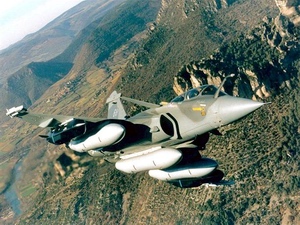
Avion de combat Rafale B - Dassault Aviation
Finally, May 19, 1991, witnessed the inaugural flight of le Rafale C, a very ultra modern plane with electric digital flight controls, capable of carrying a six-tonne load of weapons. Some of its critical parts are made of titanium or carbon and it has a reduced radar signature. It is a Mach 2, equipped with a specially designed zero-zero ejection seat with an inclination of 32 degrees, carefully calculated such that the negative ejection G is spread over the entire surface of the body.


 French fighter planes from the Second World War till date