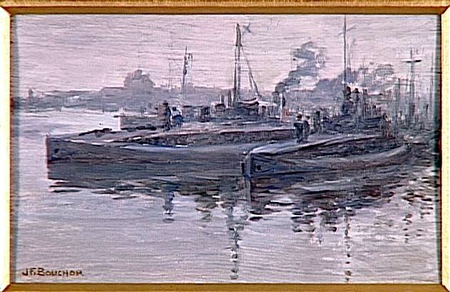
Les sous-marins
Bouchor Joseph-Félix
Dunkerque, décembre 1916 Musée national Blérancourt
The French Navy
The Navy
Technological Evolution of Submersibles and Submarines
Silent, yet formidable devices...
Four fifth of the surface of the globe is covered with water. Very far back in history, men started using boats, and later on ships, to carry out trading activities and move from one country to another.
Soon after, warring parties started imagining how they could hide themselves under water to destroy surface ships. Leonardo da Vinci was the first to conceive the idea of underwater attack and designed a diving apparatus.
A rather difficult beginning…
It wasn’t until the American War of Independence that the underwater weapon actually made its debut. David Bushnell invented the Turtle, with a shape reminiscent of a tortoise and its two joined carapaces. Piloted with the hand and the foot by a single person, the Turtle became popular in 1776 when it carried out an unsuccessful attack on an English frigate, the Eagle, lying at anchor.
A quarter of a century later, in 1800, another American, Robert Fulton, immersed his Nautilus in the Seine. This submersible navigated on the surface using sails and under water using a hand-turned propeller, pure muscular force.
Sails on the surface... and hands underwater...
During the Secession War, the Confederates constructed submersibles called "David", still manually propelled, with the aim of attacking blockade ships of the Federal fleet. Manning each David was one captain and a crew of eight, whose main job was to turn the propeller with the help of a long crank handle.
The David were said to have drowned thirty five men before succeeding, on February 17, 1864, to sink a wooden corvette called Housatonic. But, the one David which accomplished this mission did not even live to savour its victory as it was catapulted by its very success to the bottom of the sea, next to its defunct enemy…
As long as muscular force hadn’t been replaced by the engine, the submersible could not be considered a weapon of war with navigating capabilities. Yet, it was only in 1860 that the engine appeared on the “Plongeur” (the Diver) of Captain Pierre-Joseph Bourgeois of the French Navy. It used compressed air to function, but the issue of stability of the vessel when immersed remained unresolved, and it turned out to be a flop.
A few years went by before, in 1881, in the United States, an inventor of Irish origin named John Philip Holland constructed his third boat, Holland III, weighing 19 t, driven by a 15-horsepower engine capable of functioning under water using compressed air, and equipped with ballasts and horizontal rudders in the rear. This was a remarkable progress, but another serious issue arose, that of an attack weapon. The solution came from a Briton, Robert Whitehead, with his air-actuated automobile torpedo.
Frenchmen and the electric novelty
In France, two engineers of the the French Navy, Henri Dupuy de Lôme and Gustave Zédé, with the support of Admiral Hyacinthe Théophile Aube, then Minister of the Navy, invented the Gymnote (30 t), launched in 1888. It came along with a promising novelty: a propulsion battery-powered electric motor. Next was the turn of Gustave Zédé, 266 t, launched in 1893, after the accidental death of the eponym engineer.
The year 1899 was characterized by the success of Morse, in France, and Holland VIII, in the United States, both of which were officially recognized as real combat vessels, despite their ridiculously small cruising radius. The most exhaustive and unrivalled success was that of the famous Narval de Laubeuf, laid down in 1898.
The Germans invented the diesel engine
In 1897, a German engineer by name Rudolf Diesel invented a high-output, internal-combustion engine bearing his name. The diesel engine which runs on gas-oil, a fuel which, unlike petrol, does not emit explosive vapour, brought the solution to the problem of propulsion in submersibles, and was rapidly embraced by navies around the world.
In 1914, the majority of submersibles in the world were powered by diesel engines (pirogues). From 1914 to 1918, the Germans built and deployed 343 of them in fighting. A total of 178 of them were sunk after having destroyed 19 million tonnes of Allied merchant ships.
A formidable weapon
Technological progress transformed submersibles into formidable weapons...
Submersibles of navies around the world in the 40’s did not very much differ from those constructed by the Germans at the end of the First World War. However, their performances and weaponry underwent considerable progress during the two world wars, with the advent of the snorkel, in 1943, standing out as the critical milestone towards the construction of a real submarine.
The snorkel is a retractable ventilator, about 8 to 10 m long, equipped with a watertight valve which automatically opens and closes as the blades rotate. Thanks to it, German submersibles, at the end of the Second World War, could recharge their batteries while shallowly under water. All submersibles had a water surface speed of 12 to 18 knots per hour, and an underwater speed of not more than 10 knots per hour.
However, in the last days of the Second World War, German submersibles known as “anaerobiont”, type "XXVI", were capable of navigating under water for one hour at 17 knots. During this war, this breakthrough would have cost the Germans lesser had Allied aviation been absent. For 15 million tonnes of Allied merchant ships sunk, the Germans lost 784 submersibles (out of the 1162 they had constructed from 1939 to 1945). Except for the Surcouf, with a displacement of 3250 t when on the surface and 4500 t when immersed, all the other submersibles each had a displacement ranging from about 250 t to about 2 800 t when on the surface. Their weaponry comprised torpedoes and cannons, and sometimes underwater mines.
All submersibles, when on the surface, owe their buoyancy to their emptied ballasts, which represent about 20 % of the vessels displacement. On the lower part of these ballasts is a fill hole which is always open to the sea, and, on their upper part, is a remote controlled bleeder. To immerse the vessel, the bleeders are opened, the diesel engines are stopped, and the electric motors are started. The ballasts fill up rapidly and, once the floatability of the submersible becomes zero, it goes under water. This happens in a hydrodynamic manner when the diving rudders are properly oriented.
Sea water reservoirs – the trim tanks – allow the vessels equilibrium to be adjusted horizontally while shutting the bleeders. The immersion can be changed by manipulating the diving rudders remotely from the control room. To make the submersible rise to the surface rapidly, compressed air stored under high pressure in large reservoirs is released to flush out water from the ballasts. When the vessel emerges at the surface, the drainage of its ballasts is completed either by exhaust gas from the diesel engines, which will have been started, or using a turboblower.
The vessel, when on the surface or using the snorkel, moves thanks to one or two propeller(s) mounted on one or two diesel engine(s). When immersed, the electric motors are powered by direct current from huge batteries, which are recharged thereafter by the diesel engines.
The navigating instruments of a modern submersible are either optical (periscopes), or electromagnetic and electronic (sonar, radar and depth recorder). The periscope is a steel watertight tube, with diameter of about 25 cm and length of about 9 to 15 m. It has a well-adapted optical system with the eyepiece capable of hosting a video camera. The directivity of the prism makes it possible to have a zenithal observation of aircrafts or stars (so as to take fact-based decisions). A periscope also has an optical rangefinder.
Submersibles are equipped with torpedoes, launched by barrels fixed at the front and rear of the vessel. The torpedoes are either stored in the barrels themselves or inside the vessel (reload torpedoes). Some submersibles can be armed with mines. Cannons, which were often used during the First World War, had almost completely disappeared during the second, given that immediately a submersible was detected by the radars of an antisubmarine ship or by a plane especially, it could no longer stay on the surface to use a cannon.
The advent of nuclear submarines
With the invention of nuclear propulsion, the number of submersibles in the world has never stopped decreasing, giving way to more submarines. The first real submarine was the Nautilus of the US Navy, which was powered by energy from a nuclear reactor, and which made its debut full-way immersion on January 17, 1955. Meanwhile, tests carried out on a modified submersible made it possible to design the most suitable shapes for a real submarine, without having to take into consideration requirements related to surface navigation.
The hull of the modern nuclear submarine is made of special steel, resistant to an immersion of at least 300 m. The tonnage of the vessel is substantial - 4 500 t of displacement when immersed for the British attack submarines, Fleet Submarines, 2 670 t for the French SSNs (nuclear attack submarines) like the Rubis, and 9 000 t for nuclear ballistic missile submarines (SSBN), like the Redoutable (the Formidable). The most recent American missile-lunching submarines of the "Ohio" series have a displacement of up to 19 000 t, and the latest Russian analogue vessels displace more than 20 000 t when immersed.
The surface floatability factor of a submarine is lower than that of a submersible and its shape gives it the appearance of a giant cetacean. Some units can attain and withstand a speed of 35 knots however rough the sea is. This is a big advantage that submarines have over vessels which can only navigate on the surface.
Swift, biting sea hounds
The nuclear submarine goes under water and navigates when immersed just like a submersible. But the submarine is way superior to the submersible on several counts. To begin with, it is absolutely independent of the surface and can navigate for full months without being obliged to go (close) to the surface in search of atmospheric air to get its engines working or change the breathing air within its hull.
Next, it has an extensive cruising radius, which is about 5000 times greater than that of a submersible. This comfort would appear unrealistic to all those who knew the submersibles of the last war. Finally, the submarine has remarkable navigation instruments, notably the inertial measurement unit, which records the slightest acceleration or deceleration so that a dead reckoning position can constantly be maintained with extraordinary precision.
The nuclear attack submarine (SSN) plays an analogue role compared to that of the most recent submersibles, with torpedo weaponry complemented by submarine-launched missiles.
The SSN is an extremely dangerous enemy to all surface vessels, however powerful and fast these may be. The guided strategic ballistic missile submarine, like the Redoutable (the Formidable) of the French Navy, which has been assigned the permanent role of a second striking power, is armed with 16 undersea to surface missiles with megatonnic nuclear charge, which is launched when under water. Moreover, it has its own defence system – four torpedo-launching barrels and reload torpedoes. The guided missile submarine constitutes the backbone of the French nuclear deterrent force.