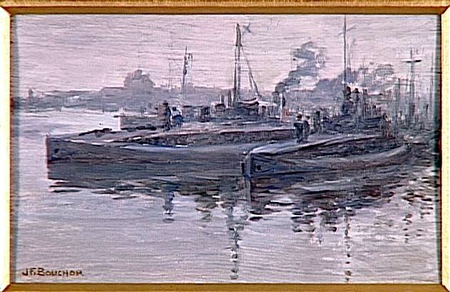
Les sous-marins
Bouchor Joseph-Félix
Dunkerque, décembre 1916 Musée national Blérancourt
The French Navy
The Navy
Submersibles during the First World War
The submersible, a merchant ship hard-kill weapon
During the First World War, the principle of a freight traffic hard-kill weapon, masterminded by Admiral Von Tirpitz, oriented the construction of diesel engine/electric motor submersibles that were used extensively in fighting.
The Germans used these devices to destroy warships and merchant ships. The U20 series (500 to 650 tonnes), called “pirogues” by those who used them, sank 11 million tonnes of such vessels. The “Lusitania” liner was also sunk by a U20, and that, among other reasons, pushed the United States to join the war.
It should be noted that Austrian submarines had already adopted a low water profile that was later on implemented on “atomic” missile launchers.
Meanwhile, nations continued to research on how submersibles could be given greater autonomy, equipped with underwater detection capabilities (passive hydrophones), and have a bigger capacity for large-scale sea raids.
From 1914 to 1918, the Germans built 343 such vessels, which, during fighting, destroyed 19 million tonnes of Allied merchant ships, at the price of 178 submersibles.