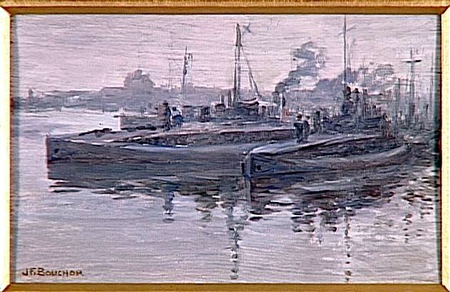
Les sous-marins
Bouchor Joseph-Félix
Dunkerque, décembre 1916 Musée national Blérancourt
The French Navy
Air-Independent Submarines
France, German and Sweden came out with the Walter project of the air-independent propulsion (AIP) turbine. The French "MESMA" (Module d'Energie Autonome Sous-Marin) type steam turbine AIP system burns ethanol and oxygen to obtain steam, which is used to actuate a turbo-generator. The design is such that it can subsequently be adapted to existing submarines by fitting out an additional hull section. The average cost of a new MESMA-powered submarine is in the neighbourhood of 250 million dollars.
The DCNI (Direction des Constructions et Armes Navales Ingénierie) provides the MESMA option for its Agosta submarines. According to the company, its AIP option increases underwater autonomy by a "factor of 3 to 5." The design of a MESMA system makes it readily mountable as an attachment on many contemporary submarines, by creating an additional hull section. Pakistan bought three Agosta submarines; the last one which will be built in Pakistan, will be equipped with the AIP MESMA system and will most probably be the first MESMA submarine in the world.
The MESMA is an extremely soundless system, far more silent than any nuclear steam supply system (NSSS). When it is combined with an efficient, well-organized crew like Frenchmen or Swedes, equipped with listening instruments like Englishmen or Frenchmen, and weapons like Englishmen or Swedes –mastery commensurate with the system and adequate weapons – such a submarine would be capable to rival just any American nuclear submarine. AIP submarines costing between 100 and 300 million dollars are considerably as good as US nuclear submarines, which are 5 to 16 times more expensive.
Various research projects on propulsion and stealth have been launched, and the prototype of an even more silent and powerful engine is already running. It is know as the magneto-hydrodynamic engine. Symmetrically, it is possible in theory to directly exploit – without any mobile component – a fluid movement to generate electricity simply by transforming its kinetic energy using an MHD generator. Superphénix is said to have used this process to actuate pumps.
In less esoteric language, it suffices to boost and recombine the electricity contained in seawater before canalizing it through a hollow magnetic pipe maintained at absolute zero temperature by liquid helium. The electric current so generated creates an extremely powerful force which pumps water through stern thrusters.
Practical achievements in this regard, at the beginning of the XXI century, are still at an experimental stage or still concealed in the name of military secrets. There are many issues yet to be resolved like the generation of strong magnetic fields or the checking of the electrolysis of the gaseous plasma...