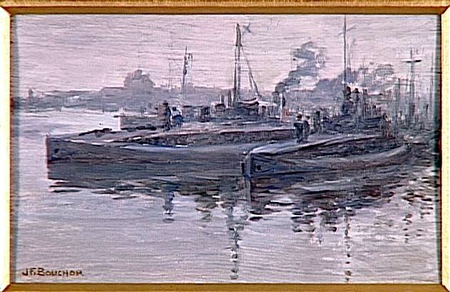
Les sous-marins
Bouchor Joseph-Félix
Dunkerque, décembre 1916 Musée national Blérancourt
The French Navy
Nuclear Submarines
The post-ware period witnessed the advent of nuclear-powered engines, a landmark development in the evolution of submersibles into real submarines with more advanced communication and sensory means, such as radars, microphones, sonar and very low frequency radios, encrypted satellite links, etc.
The hull of the modern nuclear propulsion submarine is made of special steel, which is resistant to an immersion of at least 300 m.
It is a ship with a huge tonnage - 4500 t underwater displacement for British attack submarines (Fleet Submarines), 2670 t for French SSNs (nuclear attack submarines) like the Rubis, 9000 t for nuclear ballistic missile submarines (SSBN), like le Redoutable (the Formidable). The most recent American guided missile submarines of the "Ohio" class can displace up to 19000 t, and the last analogue Russian vessel displaces over 20000 t when immersed...
The surface floatability factor of a submarine is lower than that of a submersible and its shape gives it the appearance of a giant cetacean. Some units can attain and withstand a speed of 35 knots however rough the sea is. This is a big advantage that submarines have over vessels which can only navigate on the surface.
The nuclear submarine dives and navigates under water just like a submersible. But the submarine is far superior to the submersible on several counts. To begin with, it is absolutely independent of the surface and can navigate for full months without being obliged to go (close) to the surface in search of atmospheric air in order to get its engines functioning or to change the breathing air within its hull.
Furthermore, it has a broad cruising radius, which is about 5000 times greater than that of a submersible. This is an asset which would appear unrealistic to all those who knew how uncomfortable submersibles of the last war were. The last advantage worth highlighting is the remarkable navigation instruments which the submarine has, notably the inertial measurement unit, which records the slightest acceleration or deceleration so as to constantly maintain a dead reckoning position with extraordinary precision.
The SSBN, a key element of the nuclear deterrent force
The most important missions are those of the SSBN. These are vessels which are capable of firing nuclear missiles across distances of over 5000 kilometres and causing apocalyptic destructions, a characteristic which makes them an essential element of the deterrent force wanted by General de Gaulle. The French Navy received 6 SSBN of approximately 130 m in length, more than 10 m in diameter, and about 9000 tonnes in displacement. They have a cruising speed of over 20 knots.
Le Redoutable (the Formidable) lying at anchor
The SSBN are equipped with sixteen M45 missiles, with the following specifications:
Length: 11.05 m
Diameter : 1.93 m
Weight: 36 t during launching (1st stage: 20 t; 2nd stage: 8 t; 3rd stage: 1.5 t)
Weapons load: Six TN71 stealth nuclear warheads of about 150 kt.
This represents a destruction capacity of 640 Hiroshima per submarine...
The names of these SSBN are: le Redoutable (the Formidable), le Terrible (the Terrific), le Foudroyant (the Furious), le Tonnant (the Thunderous), l'Indomptable (the Indomitable) and l'Inflexible (the Inflexible). The first one of them was commissioned in 1972.
It should be noted that the early SSBN are progressively being replaced by new generation nuclear ballistic missile submarines like le Triomphant (the Triumphant), le Téméraire (the Fearless), le Vigilant (the Vigilant). Their operating base is at l'Ile Longue, in Finistère. With the Super Etendard planes of the Fleet Air Arm, these mastodons constitute the bulk of the French deterrent force.
“Sleep in peace, we are keeping watch” could be a good motto for them
Le Triomphant launched in 1989 is one of the pioneer SSBN (or even the very first) not to have been equipped with a propeller, but rather with a streamlined screw-pump, directly inspired by the turbojet of aircrafts. It is a system which banks on the feedback of water, thus preventing cavitation phenomena. The hull, which is entirely designed to achieve the "highest speed" under water by minimizing resistance, has a "skin" (anechoic coating) which absorbs sonar signals.
The SSN, the most dreadful enemy of surface ships
The SSN (nuclear attack submarines), on their part, have as mission to search and destroy ships and land targets, escort convoys, as well as infiltrate enemy territory to rescue commandos. SSN have a length of 72 m, a diameter of 7.60 m and a tonnage in the neighbourhood of 2500 tonnes. They are armed with ship-to-ship, anti-aircraft, and cruise missiles, as well as torpedoes and mines. There are six of them, namely: Rubis, Saphir, Casabianca, Emeraude, Améthyste and Perle. Their operating base is at Toulon.
However, the SSN turned out not to be quite suitable for some coastline commando streaming missions, or for the watering of mines near the coast, due to its relatively huge draught. A new type of submarine had to be invented: the anaerobic submarine.